








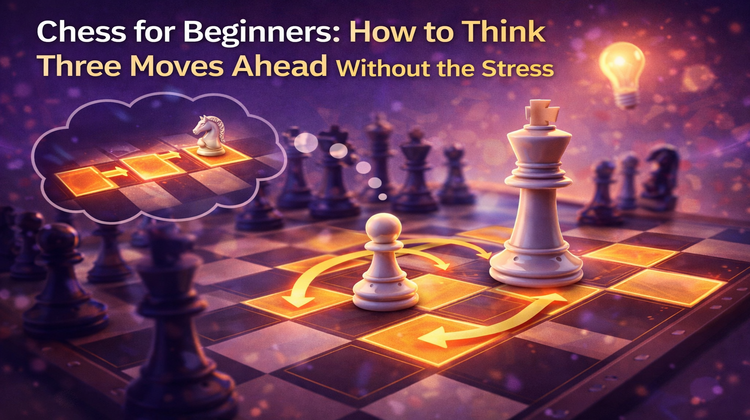
People often say that thinking ahead in chess is like a huge feat of memory, with Grandmasters supposedly being able to figure out 20 moves ahead. For a beginner, this sounds less like a hobby and more like a stressful exam.
But here is a secret: you don’t need to see the entire game to win. You just need to see three moves.
On Gamiio.com, we believe gaming should be a “useful hobby”, one that improves your mind without burning you out. Here is how you can start thinking three moves ahead in chess, stress-free.
1. The “Checks, Captures, Threats” Formula
The most stressful part of chess is trying to think of all the moves you could make. Don’t treat your brain like a computer. Use the CCT (Checks, Captures, Threats) filter instead.
When it’s your turn, only look at moves that:
- Look at the king of the other player.
- Capture an undefended or lower-value piece.
- Attack a major piece (like the Queen).
By narrowing your focus to these “forcing moves”, you cut out 90% of the noise, making the next three moves much easier to visualize.
2. Master the “If I… Then They… Then I…” Method
To think three moves ahead, you only need to complete one simple sentence in your head:
“If I move my king here, then they will likely move their bishop there, and then I can take their pawn.”
The Pro Tip: Don’t worry about the “perfect” move. As a beginner, focus on response consistency. If your move forces your opponent into a specific response (like moving their king out of check), you’ve successfully predicted the future. That is a calculation in its simplest form.
3. Don’t Calculate, Recognize Patterns
Grandmasters don’t really “count” every move, they look for patterns. Think of it like reading. You don’t spell out “C-A-T” every time you see the word, you just see “cat”.
To reduce the stress of thinking ahead, spend 10 minutes a day on Gamiio’s puzzle games.
- Forks: attacking two pieces at once.
- Pins: Holding something in place so it can’t move without losing something bigger.
- Back-Rank Mates: Putting a King behind its own pawns with a Rook.
You don’t have to do as much “calculating” if you can see more patterns. Your brain will automatically “see” the third move.
4. The “Safety Check” (The 0-Move Calculation)
Do a “0-move” safety check before you even think about move three. Think about:
“Is my opponent able to check or capture me right away?”
A lot of beginners get so worked up about attacking that they forget to protect themselves. When you make “King Safety” your top priority, you don’t have to worry about making mistakes. Your brain is much better at creative maths when you feel safe.
5. Play “Micro-Chess” on Gamiio.com
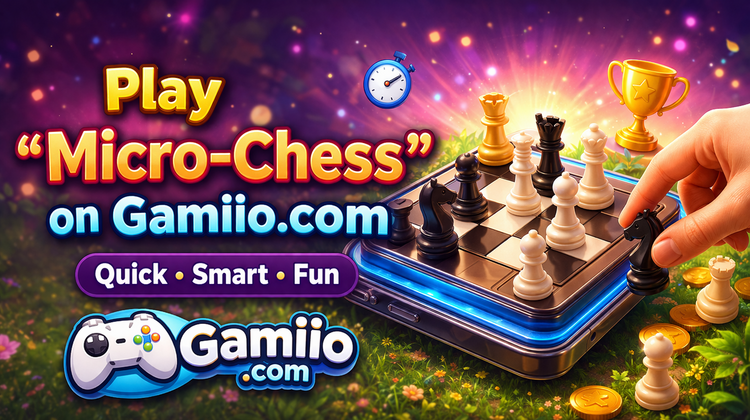
Micro-Gaming is the best way to practise thinking ahead without the stress of a 60-minute game.
You can start a quick game of chess right away at Gamiio.com. No downloads, no high-stakes rankings, just you and the board.
- Try our “no-barrier” Chess: You can play it on your phone or PC.
- Use the “undo” button: If you calculated wrong, see where you missed the line and try again. This “feedback loop” is how you teach your brain to see more.
Conclusion: It’s a Hobby, Not a Chore
It’s a skill to think three moves ahead, but it’s also a way to clear your mind. It tells you to stop reacting to life and start making plans for it.
Don’t just look at your phone when you take a break next time. Go to Gamiio.com, start a game of chess, and try the CCT formula. You won’t believe how quickly “three moves ahead” becomes second nature.
Are you ready to test your focus? Play Chess on Gamiio now!