









Games are becoming more intelligent. Developers may create more expansive worlds faster with generative AI, and gamers can interact with constantly changing landscapes. We’ll examine how this technology is changing online games in this piece, both for the players in front of the screen and the teams behind them.
How Does Generative AI Work in Games?
Whether it’s background music, a map, or a character narrative, generative AI analyzes existing data, finds patterns, and creates something new from it. Although it is utilized in many different industries, virtual environments that change, adapt, and develop in reaction to player actions are what make it unique in the gaming industry.
Your choices can affect conversations, happenings, and even the surroundings. The world may respond to your advancement in subtle ways, and one player’s interpretation of a quest may conclude quite differently from another’s.
A well-designed AI game should feel more customized and alive rather than simply pre-written. It’s a method to maintain the experience’s novelty and make it seem like your story rather than just the game’s.
Benefits for Players: Modified and Changing Worlds
The way unscripted games begin to feel is what attracts gamers to generative AI. The course of a mission is not always the same. Characters may say something new, a city may expand differently, and adversaries may not always follow the same patterns.
Additionally, it may customize the experience to fit your playing preferences. Maybe it changes the story’s pace, adjusts the challenge, or highlights your favorite aspects of the game. You don’t feel pressured to purchase something that fits.
Accessibility is also improving. Some games are becoming easier for more players to learn thanks to voice instructions, adaptive menus, and even auto-localized voiceovers. Characters can now react organically, remember your decisions, and converse with you in some games, which greatly enhances roleplay and exploration.
The Behind-the-Scenes Use of AI by Developers
There are many small jobs involved in creating a game, such as placing items, creating filler conversation, and testing the same level a hundred times. Generative AI can help with that. It helps fast or automate operations that typically take hours, freeing up teams’ time for important ideas.
Creative Difficulties and Ethical Issues
The use of AI in video games raises serious issues. Who is the owner of content produced by artificial intelligence? How can one moderate a conversation that was not written by a human? What happens if a game inadvertently contains offensive or prejudiced content?
It’s simple to ask if games will become less distinctive if everyone relies on AI. A lot of studios are already thinking about this and stressing that AI should enhance creativity rather than take its place.
Additionally, clear communication is essential. Knowing which aspects of a game were influenced by AI is appreciated by players. Being honest with developers fosters trust.
Additionally, the field of ethical AI creation is expanding in game studios. It entails establishing limits, ensuring that outputs are fair, and upholding a human review process, particularly when information is created in real time.
AI Gaming’s Future
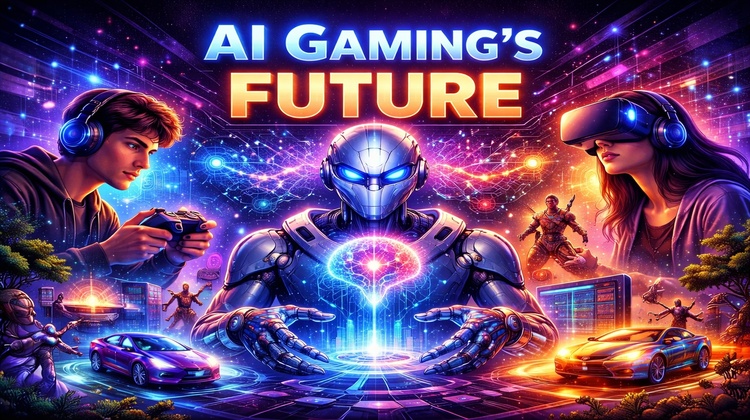
AI has the potential to advance dynamic gaming in the future. Real-time game world evolution is possible, with new content linked to player actions. You could encounter foes that change, explore towns that expand, or even create narratives with NPCs that feel more like creative collaborators.
Instead of releasing games as fixed, one-and-done versions, anticipate a more modular design. When paired with machine learning, these systems might even be able to anticipate and create content in real time based on what communities would want in the future.
AI in Gaming and Browser Games: Significant Innovation, No Install Required
AI is no longer limited to big-budget AAA games. It is also changing browser games, making them more intelligent, dynamic, and captivating. Gamiio is leading this new trend. AI is used in several of its games to change the course of events based on your choices, introduce new content, and keep things interesting. You can just start playing because there is nothing to download.
This change might turn web games into a testing ground for innovative concepts. Faster testing and iteration are possible for developers. Gamers can instantly try something new. Experimentation becomes a crucial component of the core loop when there is less technical overhead.
Browser games may become more social as AI capabilities become more widely available. Player-generated content created with AI assistants, cooperative storytelling, and shared AI-driven worlds could all appear sooner rather than later.
A More Intelligent Future for All
AI is now influencing the creation, development, and gameplay of video games rather than only serving as a background utility. More gamers are realizing the benefits of AI in games, such as less repetition, deeper narratives, and unexpected moments. Developers are using it behind the scenes to experiment more freely and build more quickly.
It’s a method to make this technology accessible to the general public without requiring a high-end PC or console, thanks to platforms like Gamiio.com. Simply launch a tab, begin a session, and follow the game’s path.
The future of gaming is being shaped by machines, and it appears to be more inventive than ever, regardless of whether you’re here for light entertainment or in-depth immersion.